NASA's IXPE Unveils Cosmic Feeding Frenzy: White Dwarf's X-Ray Secrets Revealed
NASA's IXPE Unveils Cosmic Feeding Frenzy: White Dwarf's X-Ray Secrets Revealed
For the first time, scientists using NASA's IXPE mission have captured detailed X-ray polarization data from a white dwarf star, revealing the hidden mechanics of a "cosmic feeding frenzy."
The target of this groundbreaking observation was EX Hydrae, an intermediate polar system located approximately 200 light-years away in the constellation Hydra. An international team of researchers, led by scientists from the Massachusetts Institute of Technology (MIT), published their findings in the Astrophysical Journal.
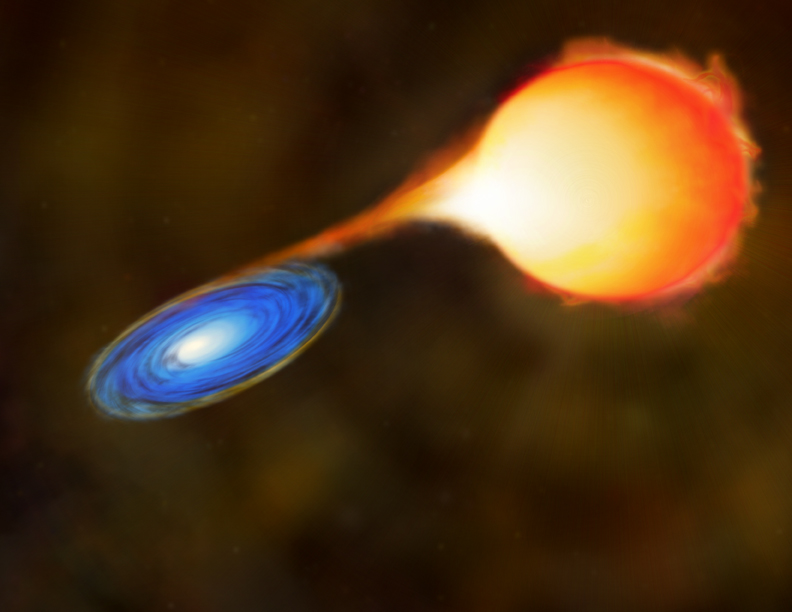
White dwarfs are the extremely dense remnants of stars that have exhausted their nuclear fuel. EX Hydrae exists in a binary system with a companion star, from which it continuously pulls gas via a process known as accretion. Because of its moderate magnetic field, EX Hydrae is classified as an "intermediate polar," where the incoming material forms a swirling accretion disk while also being channeled towards the dwarf's magnetic poles.
"NASA IXPE's one-of-a-kind polarimetry capability allowed us to measure the height of the accreting column from the white dwarf star to be almost 2,000 miles high – without as many assumptions required as past calculations," said Sean Gunderson, MIT scientist and lead author of the study. "The X-rays we observed likely scattered off the white dwarf's surface itself. These features are far smaller than we could hope to image directly and clearly show the power of polarimetry to 'see' these sources in detail never before possible."
As the gas spirals inward, it reaches temperatures of tens of millions of degrees Fahrenheit. It then collides with material bound to the white dwarf, forming tall columns of hot gas that emit intense X-rays. The unique ability of the Imaging X-ray Polarization Explorer (IXPE) to measure the polarization of these X-rays provided the team with unprecedented insights into the geometry and dynamics of this extreme environment. This marks a significant step forward in understanding accretion processes not just in white dwarf systems, but in other highly energetic binary star systems across the universe.
The IXPE mission is a collaboration between NASA and the Italian Space Agency, with science partners in 12 countries. Launched to study the polarization of X-rays from highly energetic cosmic objects, IXPE's observations of EX Hydrae demonstrate its powerful potential for unlocking the secrets of the universe's most extreme environments.
References
- NASA - IXPE Measures White Dwarf Star for First Time
- ScienceDaily - A White Dwarf's Cosmic Feeding Frenzy Revealed by NASA
- ASD News - NASA's IXPE Measures White Dwarf Star for 1st Time
- Chandra X-ray Observatory - White Dwarf Illustrations
Image: Artist's concept of EX Hydrae, a white dwarf star (left) pulling material from a larger companion star into an accretion disk. Credit: MIT/Jose-Luis Olivares
Members Discussion